

Sowing seed treatment for lettuce and endive
Lettuce and endive
In the cultivation of lettuce and endive, seed and soil-borne fungi can cause germination and emergence problems. Immediately after sowing, fungi on or in the vicinity of the seeds come to life. For lettuce and endive, these major fungi are treated with Maxim® 480FS. Both FarMore® Technology seed treatment products ensure that the germinating seed develops into a strong plant: the basis for a good lettuce and endive yield.





Lettuce and endive diseases
FUSARIUM SPP. – fusarium wilt | The disease Fusarium oxysporum is common in lettuce and endive. Characteristic of fusarium wilt are wilting and total root rot. A pinkish mildew may also be visible. The disease may be seed, wind or soil-borne or spread on plant material. At a temperature of 27°C and a pH of less than …
MICRODOCHIUM SPP. – ring spot | The disease Microdochium spp. is common in lettuce and endive. The first symptoms are tiny water-soaked spots (2-3 mm) on the crown. As the lesions enlarge, they turn yellow and are usually angular. In cool, humid conditions, whitish pink fused masses of …
PYTHIUM SPP. – root rot | The disease Pythium spp. is common in lettuce and endive. Root rot is a secondary parasite which particularly affects young plants. The disease is first visible at the roots, which turn blackish brown and show signs of rotting. Thick-walled resting spores develop in the diseased tissue which …
RHIZOCTONIA SPP. – black scurf | The disease Rhizoctonia solani is common in lettuce and endive. High humidity will intensify black scurf. The disease can be identified at an early stage by leaf spots just above the ground and in the middle of the outer leaves. These lesions can prevent or impede further crop growth. At high humidity levels …
SCLEROTINIA SPP. – lettuce drop | The disease Sclerotinia spp is common in lettuce and endive. Lettuce drop affects the stems and leaves that are in contact with the soil. Infected tissue will develop a brown watery decay. Plants will wilt and collapse. White mycelia and small (3-5 mm), irregularly shaped black ...
FarMore® Technology
FarMore® Technology is a vegetable seed treatment platform developed for and focused on the customer's needs. Syngenta is dedicated to developing innovative products adapted to each individual vegetable crop by combining seed treatment solutions, application technologies and services.
FarMore® Technology is not a stand-alone product; it is a constantly evolving technology platform that showcases Syngenta's full commitment ...
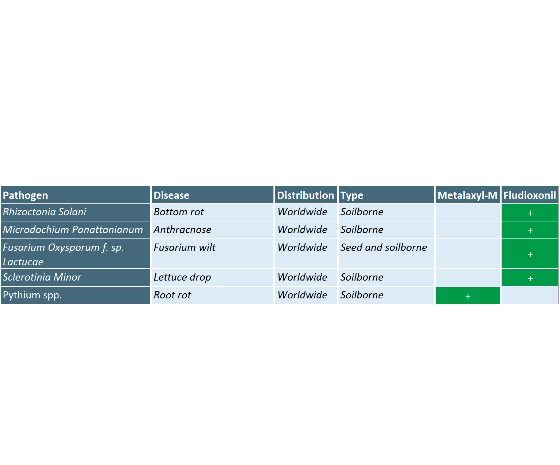
Table of diseases | efficacy of FarMore® Technology
FarMore® Technology can improve seedling emergence and vitality by effectively controlling a range of seed and soil-borne fungi. The table shows the control spectrum of Maxim 480FS (Fludioxonil) and Apron XL (Metalaxyl-M). It indicates which fungi that pose a risk to lettuce and endive the FarMore® solutions can control. For more information on the efficacy of FarMore® against fungi in lettuce and endive, please see the test results.