

Seedcare in brassicas
Brassicas
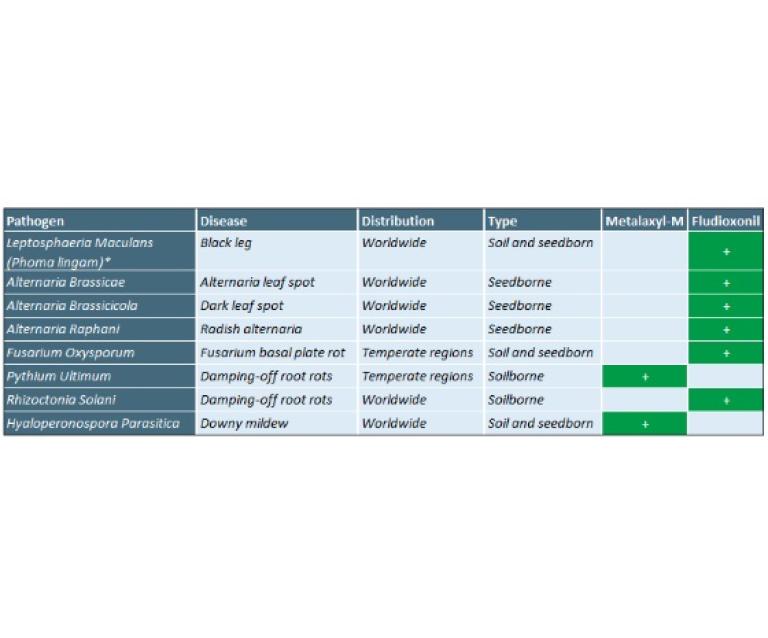
In the cultivation of brassicas, seed and soil-borne fungi can cause germination and emergence problems. Immediately after sowing, fungi on or in the vicinity of the seeds come to life. For brassicas (cabbages, brussels sprouts, cauliflower, broccoli, borekole, lambs lettuce), these major fungi are treated with Apron® XL and Maxim® 480FS. Both FarMore® Technology seed-treatment products ensure that the germinating seed develops into a strong plant: the basis for a good brassica yield.





Brassica diseases
ALTERNARIA SPP. – leaf spots | The diseases Alternaria brassicae, Alternaria brassicicola and Alternaria raphani are common in brassicas. Leaf spots cause a loss of seedlings. Dark brown to black lesions develop on the leaves, usually with a yellow edge. As these lesions grow, the whole leaf may discolour. The disease develops most rapidly at a temperature of …
FUSARIUM SPP. – fusarium wilt | The disease Fusarium oxysporum is common in brassicas. Characteristic of fusarium wilt are wilting and total root rot. A pinkish mildew may also be visible. The disease may be seed, wind or soil-borne or spread on plant material. At a temperature of 27°C and a pH of less than …
LEPTOSPHAERIA SPP. – black leg | The disease Leptosphaeria maculans is common in brassicas. Black leg causes leaf spots varying in colour from greenish brown to tawny, yellow or nearly white. Spots contain numerous, dark carpophores. The spots tend to be circular or oval in shape and between 0.5 and …
PYTHIUM SPP. – root rot | The disease Pythium ultimum is common in brassicas. Root rot is a secondary parasite which particularly affects young plants. The disease is first visible at the roots, which turn blackish brown and show signs of rotting. Thick-walled resting spores develop in the diseased tissue which …
RHIZOCTONIA SPP. – black scurf | The disease Rhizoctonia solani is common in brassicas. High humidity will intensify black scurf. The disease can be identified at an early stage by leaf spots just above the ground and in the middle of the outer leaves. These lesions can prevent or impede further crop growth. At high humidity levels …